Keep bleach away from anything acidic and anything with ammonia in it, and don't combine any two household cleaners, even ones that seem mild. That's Health Canada's rule, and it's simpler to follow than a list of forbidden pairs. The trouble is that most people never pour two bottles into one bucket on purpose. The mix happens on a surface: a toilet bowl that still holds the last product, a mirror sprayed beside a freshly bleached tub, a tap wiped with one spray and then another.
Health Canada warns that bleach mixed with glass or toilet bowl cleaners gives off toxic gas
In its public advisory on toxic gases, Health Canada reported that Canadian Poison Centres received more than twice as many reports of chloramine exposure in October and November 2020 as in the same two months of 2019. Chloramine is one of the gases that forms when bleach meets ammonia. The advisory names the everyday products behind it:
These gases result from mixing bleach with products such as glass cleaners, toilet bowl cleaners, or other products containing ammonia or acids
Its household chemical safety page goes further than bleach. Among its tips for using any household chemical product is a plain instruction: never mix household chemical products together, because some mixtures produce harmful gases. That covers two different drain openers poured down the same clogged sink, and a homemade blend of whatever was under the counter.
The risky pairs meet in four places around a home
Look at where each product is used, not only at what's in the bottle. These are the spots where a bleach product and an acid or ammonia product tend to end up on the same surface within minutes of each other.
| Room | Products that often share it | How they meet |
|---|---|---|
| Toilet | A bleach gel or tablet, and a toilet bowl cleaner | One is still in the water or under the rim when the other goes in |
| Tub, shower and tiles | A bleach spray for grout, and vinegar or a limescale remover for taps and glass | Both sprayed in the same session on surfaces that touch, with runoff collecting at the drain |
| Mirrors and windows | A glass cleaner, and bleach used nearby on the sink or windowsill | Overspray from one lands on a surface still wet with the other |
| Kitchen sink and drain | Diluted bleach for the sink, vinegar for scale on the tap, a drain opener | Each poured or sprayed into the same basin before the last one was rinsed away |
A limescale remover is acidic by design, which is how it dissolves mineral deposits. If you use one on taps and glass doors, our article on hard-water spots in GTA bathrooms covers the method for each surface.
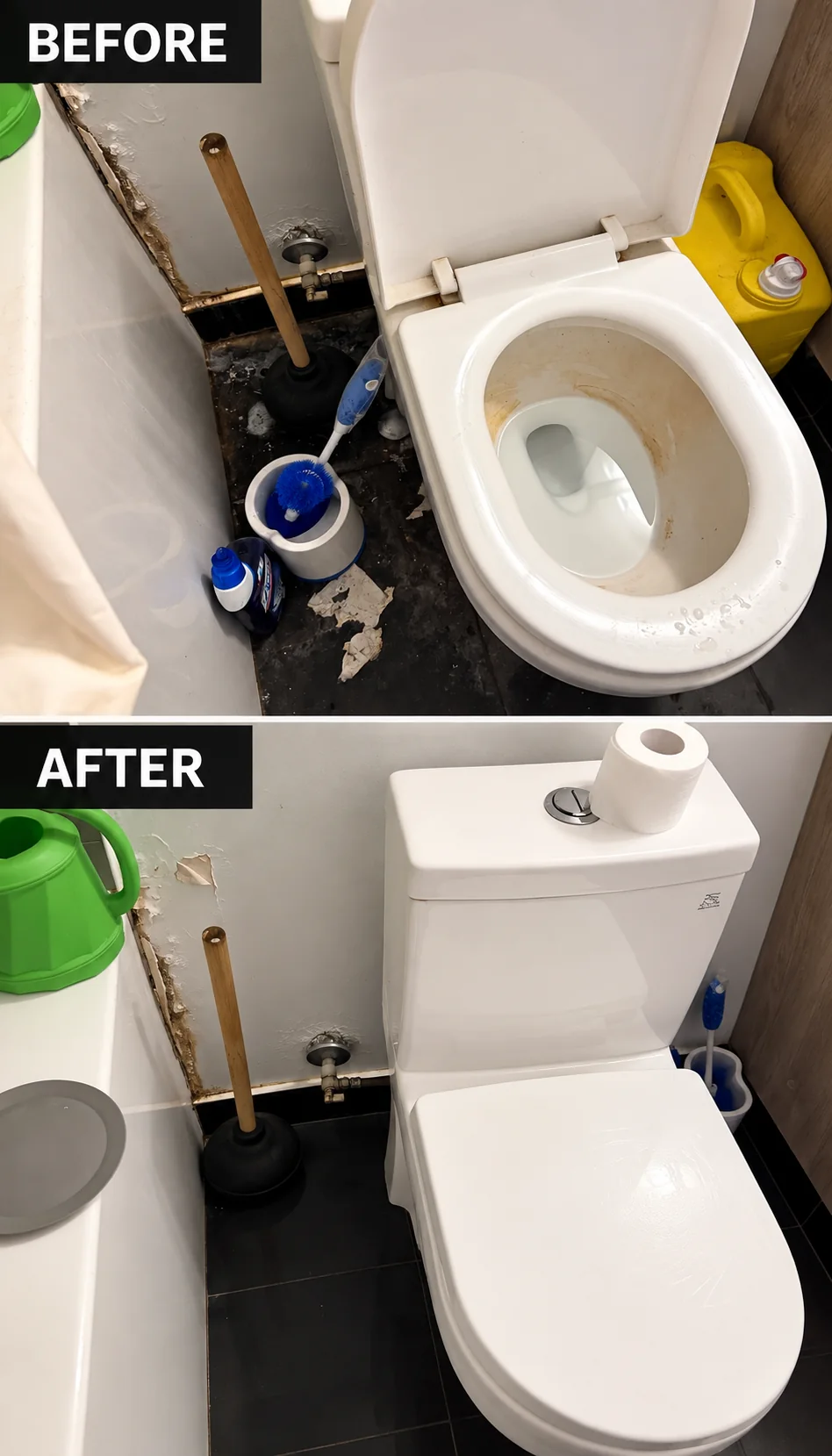
The toilet bowl is where two products meet most often
Water in the bowl hides what's already there. A cleaner squeezed under the rim an hour ago can still be sitting in it, and a tablet in the tank keeps releasing product into every flush. Before a second product goes in, flush once and let the bowl refill with clean water. If the tank holds a cleaning tablet, read its label before you add anything else to the bowl.
A Canadian product label tells you the danger in three parts
Health Canada's guide to hazard symbols says each one has a picture, a frame and a signal word underneath. Reading all three takes a few seconds and tells you how careful to be before the cap comes off.
The picture: what kind of danger
- Explosive: the container can burst if it's heated or punctured.
- Corrosive: the product can burn skin or eyes, and damage the throat and stomach if swallowed.
- Flammable: the product or its fumes catch fire easily near heat, flames or sparks.
- Poison: swallowing, licking or sometimes breathing it can make a person very sick or kill them.
The frame: the container or what's inside
A triangle around the picture means the container itself is the hazard, for instance one that could burst if heated. An octagon means the contents are dangerous.
The signal word: how serious
- CAUTION: temporary injury may result, and death with extreme exposure.
- DANGER: temporary or permanent injury, or death.
- EXTREME DANGER: a very small amount may cause death or serious injury.
The first aid instructions sit inside a border on the back or side of the label. Find them before you start, not after.
Clean one bathroom with one product at a time
The order below keeps every product on its own surface and gives each one a rinse before anything else touches it.
- Open the window or switch on the exhaust fan, and leave it running until you're done and for a while after.
- Set out only the products this room needs. Leave the rest in the cupboard so nothing gets picked up by mistake.
- Flush the toilet and let the bowl refill before any product goes into it.
- Do every surface that needs bleach first: the bowl, the grout lines, the shower corners. Rinse each one with plain water when the label's contact time is up.
- Rinse the tub floor and the drain so no bleach is left where the next product will run.
- Only then move to the descaler on the taps and glass, and rinse those too.
- Use the glass cleaner last, on mirrors that are already dry.
- Close every cap fully and put the bottles back before you leave the room.
If you mix diluted bleach yourself, Health Canada's ratio for 5% household bleach is 20 mL of bleach to 1 litre of water, and it says to pour the bleach into the water, never the water into the bleach. Make only as much as you need for that day.
If anyone breathes in fumes from a mix, call a poison centre
Health Canada lists burning eyes and light-headedness among the effects of these gases, and says they can be deadly. Leave the room and get fresh air first. Its instructions for when someone may have been harmed by a household chemical product:
- Call a poison centre or your health care provider right away.
- Tell the person who answers what the product label says.
- Bring the product container with you when you go for help.
- Report the incident to Health Canada afterwards.
Leftover cleaners in Toronto go to hazardous waste, not the drain
Health Canada advises against keeping leftover diluted bleach in a container for later, because someone may use it for something else. Keep every product tightly closed in its original container, out of sight and reach of children and pets. Never reuse an empty cleaner bottle for a different product.
The City of Toronto treats bleach, ammonia-based cleaners, glass and mirror cleaners, drain cleaners and disinfectants as household hazardous waste. They don't belong in the garbage, the Blue Bin or the Green Bin, and they shouldn't be poured down a drain or toilet. The city asks that products go back in their original sealed containers and that different products are not combined in one container. You can take them to a drop-off depot or book a free Toxic Taxi pickup through 311, as the City of Toronto's household hazardous waste page explains.
Tell your cleaner which products you want used, and which you'd rather not
PavMa uses professional equipment and safe cleaning products, and family- and pet-conscious products where appropriate. If someone at home has allergies, if you'd rather nobody used bleach, or if a surface needs something particular, say so when you request the quote. The same goes for any product you've just used yourself, such as a toilet tablet in the tank or a fresh treatment on the drain.
A regular house cleaning visit covers cleaning and disinfecting the toilet, sinks and faucets, mirrors, the tub and shower, and normal water marks and soap residue. For buildup that has had months to set, a deep cleaning visit goes further into each room. Photos sent on WhatsApp help prepare the free estimate, and the scope of work is confirmed before the cleaning begins. Visits run Monday to Saturday, 8 AM to 7 PM. Request a free, no-obligation quote through the house cleaning quote form or call 437-889-1213.
Mixing cleaners: what people ask after a close call
Is it safe to use bleach and vinegar on the same day?
Yes, as long as they never touch. Use one, rinse the surface well with plain water, ventilate the room, and only then use the other on a different surface. Health Canada warns that bleach reacts with acids, and vinegar is one of them.
Can I mix two drain cleaners if the first one did not clear the clog?
No. Health Canada's rule is never to mix household chemical products together, because some mixtures produce harmful gases. Read the label of the product already in the drain for what to do next, and leave a stubborn clog to a plumber.
What does an octagon around a hazard symbol mean on a Canadian label?
It means the contents of the container are dangerous. A triangle around the symbol means the container itself is the hazard. The picture inside the frame says which kind of danger it is, and the word underneath says how serious.